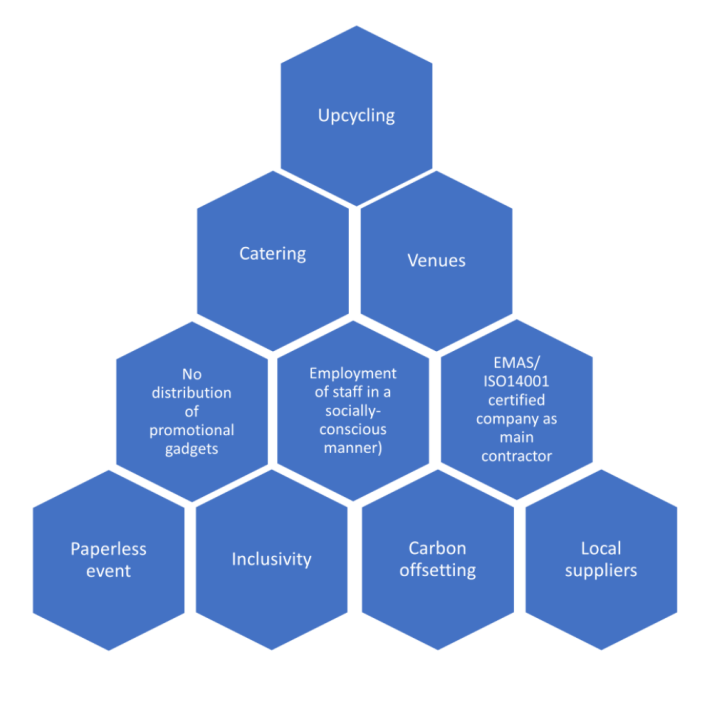

The principles of sustainability underpin the thematic focus of the European Sustainable Energy Week (EUSEW) and guide every aspect of the conference’s organisation.
The EMAS/ISO14001-certified company implementing the event works in cooperation with the European Commission (Directorate General for Energy and the European Climate, Infrastructure and Environment Executive Agency), adopting a holistic approach to sustainability that takes environmental, social and economic factors into account.
This approach forms the foundation for actions and decisions concerning the following:
- Venues: Use of venues (Charlemagne building and Martin’s Hotel) close to public transport and whose rooms require limited customisation as excessive production of new material. The Martin’s Hotel also holds the Green Key eco-label.
- Catering: Use of seasonal and local food and drink, including plant-based options for onsite catering. Prevention of food waste via redistribution of leftovers. No plastic single-use items.
- Suppliers: A focus on local suppliers for all elements of the conference’s logistics, including AV production, decoration, catering and support staff leading to a limitation of the CO2 emissions.
- Trophies production: Trophies delivered during the Awards ceremony are produced out of the wood taken from of a fallen tree from Belgium. They are levelled, planed and sanded manually. Engraving is done by an inclusivity-minded company employing disabled workers.
- Carbon offsetting: The event compensates for its carbon footprint by making a financial investment in a certified sustainable project that reduces carbon emissions and advances the United Nations Sustainable Development Goals for 2030. For the 2023 edition, carbon offsetting of the event was achieved through investment in the ‘Soutien projet de reboisement’ project in Ouffet (Belgium) and VCS Socfin Mini Hydro in Liberia.
- Decoration and materials: Conference materials from past events (banners, decorations, badges, etc.) are reused and upcycled. The conference materials used for this as well as following editions are also reused and upcycled.
- Waste: The event is paperless and no promotional gadgets are distributed.
- Employment: Staff working at the event are employed in a socially conscious way, complying with safety and labour rules and privileging disadvantaged/long-term unemployed individuals.